
In the recent years, there has been a substantial improvement in the standards of science education in school both at primary and secondary levels across the country, even though much remains to be done for schools in rural India. However, the scenario in the context of college science education is in a limbo. Science education involves, understanding the theoretical principles which are developed based on experimental observations. Without hands on experience, science education is incomplete. Due to resource constraint, laboratory infrastructure in colleges has not kept up with the times. Not much has changed in Indian colleges and laboratories of natural sciences since our undergraduate days..
Large demand from millions of students all over India to study science is met with very little enthusiasm at college level. So what should we do? The large capital investment required to modernize all the colleges with state-of-the-art infrastructure and equipment is nearly impossible.
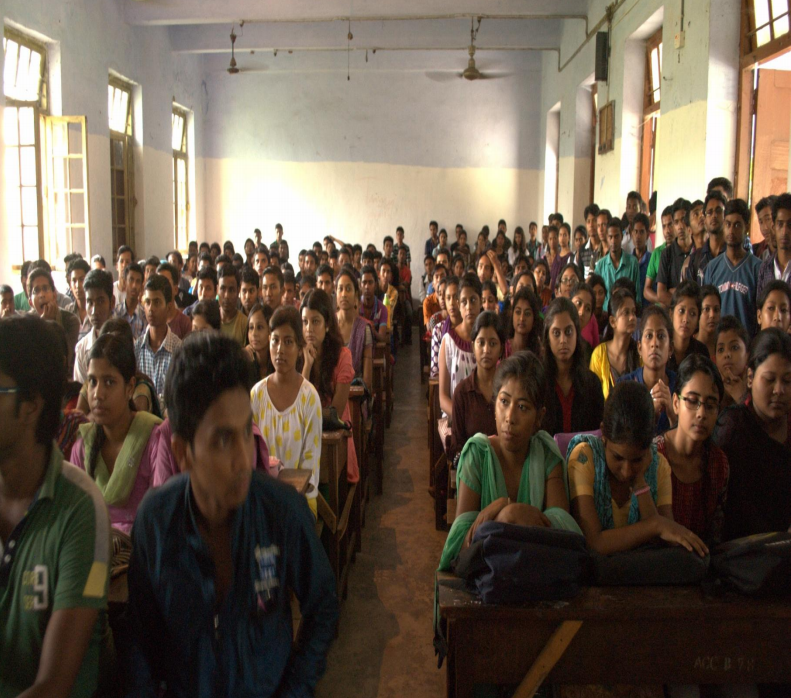
Therefore India needs to innovate an alternate model of teaching science in colleges in order to retain the enthusiasm and excitement of students, which they develop during their high school studies and which often die with their entry into college and eventually the universities. As a result of going through very limited training in experimental science at college level, it is no wonder that students, lack the ability to ask interesting questions and the desire to solve them.
Having the experience of interviewing several thousand students over last decades, both at the Indian Institute of Science as well as CSIR-Institute of Genomics & Integrative Biology, it is quite clear that basic understanding of many of the fundamental concepts are very weak among majority of the students. However, I have always been lucky to find exceptions to this and to have extraordinarily good students to work in my laboratory. What can we do to enhance the percentage of students having high enthusiasm towards pursuing science as a career and how do we direct them towards newer opportunities of science in the future?
In order to achieve this, we need to change our style from textbook based teaching to teaching through exploratory activities. For instance,. instead of teaching classical Botany in a classroom alone, one can take the students out into the field and teach them the ability to observe, analyze and deduce which I mentioned in my last blog. Today’s teaching methods have to be discreetly different with more opportunity to use low cost devices along with 3D visualizations for better learning and understanding of the basic principles of physics, chemistry and biology. There is a need to introduce students to computers at a very early age. It is also required that instead of classroom teaching, student’s participation in research activities however limited, is initiated at the college level.
To achieve this, we should be able to create clusters of colleges and students should have the mobility to interact with students from other institutions to complete their assignments. One college in the cluster can develop a laboratory with state-of- the-art facilities.
The second approach involves identifying students interested in pursuing higher studies in science and connect them with scientific leaders of the country (may be Fellows of the National Academies) so as to mentor these students and give them an opportunity to work in the science laboratories of the country. Some of the academies have already taken up initiatives in this regard.
Therefore it is required that the entire pedagogy of college teaching shifts from text book based education to practical education which involves significant interaction with research community on one side and needs of the society on the other. Engineering and Science students must be encouraged to work with MSME clusters to get hands on experience. They should be encouraged to undertake projects to make MSME cluster energy efficient, reduce waste and use less material i.e. more from less for more people without loss of quality.
One needs to be in constant touch with nature to explore new questions in the realm of science and technology. It is important to note that an early exposure to exploratory learning kindles scientific inquisitiveness that helps an individual to develop into a mature scientist in the future.
Learning from Life’s Experience
One hands-on-experiment and one explorative venture into nature is far superior to hundred lessons from the text book in kindling the scientific temper of college students.